
It's the 14th of the month, evening. Someone in a relocator chat asks "wait, did you already file last month's declaration?", and a dozen people simultaneously remember the deadline is tomorrow. Then the classic scramble: hunting for the rs.ge password, figuring out which field the Upwork income goes into, and the tempting thought of "I'll just file two months at once next time", which ends with a 0.05% daily late-payment interest charge.
The monthly declaration is the most frequent routine task for anyone running a Georgian individual entrepreneur (IE) with small business status, and the most frequent source of confusion. Half the questions in expat chats come from mixing up two different declarations: the monthly small business return and the annual income tax return. On top of that, the form itself changed in December 2024, so screenshots in older guides no longer match what you see.
Here is the whole procedure, step by step: which declarations exist, how to fill in the updated rs.ge form, how to pay your 1% through the treasury, and what a missed deadline costs. As always, this is a practice-based walkthrough rather than tax advice: edge cases deserve a check against your specific situation, or a question to us.
Quick answer
An IE with small business status files a declaration on rs.ge every month, between the 1st and the 15th, covering the previous month, and pays 1% of turnover to treasury account code 101001000 within the same window. Foreign-currency income is converted to lari at the National Bank rate on the date you received it. A month with zero income still requires a zero declaration. Being late costs a 5–10% fine plus 0.05% daily interest. How to get the status itself is covered in our guide to opening an IE; receiving income safely is covered in the bank account guide.
Monthly vs annual: the two declarations everyone mixes up
Most mistakes trace back to the word "declaration" itself. A Georgian individual entrepreneur deals with two, and they work differently.
| Monthly (small business) | Annual (personal income tax) | |
|---|---|---|
| Who files | IE with small business status | individuals and IEs with income outside the status |
| Covers | previous month's turnover | previous year's income |
| Deadline | 1st–15th of every month | 31 March of the following year |
| Rate | 1% of turnover (below the cap) | 20% of profit |
| No income that period | zero declaration still required | not needed if no taxable income |
A small business status holder lives on a monthly rhythm: twelve declarations a year, each covering the previous month. The annual return by 31 March only enters the picture if you had income outside the status: selling an apartment or a car, dividends, rental income, or salary with no tax withheld at source. If everything went through the small business status, in our practice no annual return is required, but verify that against your own mix of income.
If 31 March is looming and your numbers aren't ready, there is a legal extension: file an empty declaration by 31 March and the deadline moves to 30 June. You pay only 0.05% daily interest on the tax due, with no fine.
When to file and when to pay
The window repeats every month: the 1st through the 15th. July's declaration is filed between 1 and 15 August, August's between 1 and 15 September. The tax is paid in the same window.
A practical tip from Relocup's walkthrough: pay by the 10th. Bank transfers to the treasury are not instant, and a few days of buffer prevents the "sent on the 15th, credited on the 16th" scenario.
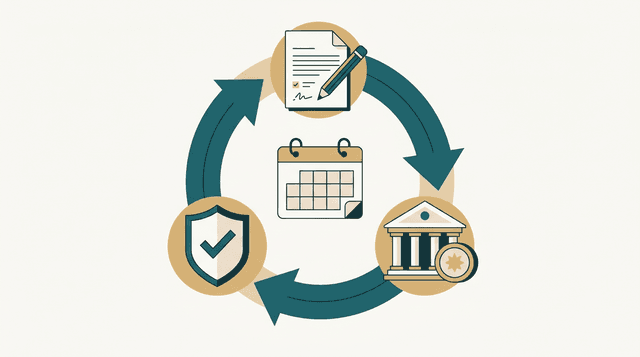
The cycle: earn income during the month → file between the 1st and 15th of the next month → pay right away → check that no debt is showing. Ten to fifteen minutes once you've done it before.
Filling in the declaration on rs.ge, step by step
The rs.ge portal is partially translated into English; the declaration form itself is in Georgian. It sounds scarier than it is: you typically fill in two or three fields.
In an r/Sakartvelo thread, user u/vanogorki described the whole procedure, quoted verbatim:
Log in to your account. If needed, switch the website to English (bottom-left corner). Click Menu (top-left). Go to Declarations. In the left sidebar, select Monthly. Open Small Business Income Declaration. Click New Return.
— u/vanogorki, r/Sakartvelo, July 2026
Then the form itself. In December 2024 it was made more detailed: previously all monthly income went into a single field, now income is split by how you received it. The current structure:
| Field | What goes in |
|---|---|
| 15 | cumulative income since the start of the calendar year (has an auto-calculation checkbox) |
| 18 | cash — via cash register or cash receipt orders |
| 19 | payments through a physical POS terminal |
| 20 | non-cash receipts: bank transfers, online payments |
| 21 | other forms — e-wallets, for example |
| 26 | tax due — calculated automatically |
The typical freelancer case, with everything arriving by bank transfer:
If you just receive money to your bank account, you only need to fill in column 20 and enter 0 in the others. You also have to fill in column 15 yourself, but they've now added a checkbox there for automatic calculation.
After that, Next and the confirmation dialogs. The declaration is submitted immediately, no moderation queue. If you're afraid of breaking something in your live account, rs.ge has a demo mode where you can click through the form consequence-free.
Paying the 1%: the treasury and code 101001000
Payment is a separate action, and it's where most people stumble: your banking app has no "tax office" in the payee list. The money goes to the single treasury account.
Yes, treasury transfer. Code is 101001000. If you are paying from your personal account (not the one that associated with your IE) then you need to select in favour of someone else/others and put your rs ge login id there.
The mechanics in the TBC or Bank of Georgia app:
- In payments, choose the Treasury section.
- Enter budget revenue code 101001000.
- In the payer field, enter your IE's registration ID.
- In the comment, state what the payment is for, e.g.
small business tax for July 2026. - The amount comes from field 26 of your declaration; rounding up to the nearest tetri is fine.
You can pay immediately after filing, no waiting required. A day or two later, check your rs.ge personal account: if the balance shows no debt, the payment landed and was allocated correctly.
Income in foreign currency: the rate on the date received
Clients pay freelancers in dollars and euros; the declaration is filled in lari. Conversion uses the official National Bank of Georgia rate on the date the income was received, not the date you file.
If your income isnt in lari, you need to convert it into lari on the date the payment is received. You can use this site to check the official exchange rate for the required date.
Rates for any date are in the NBG archive. With many payments per month, a simple spreadsheet helps: date, amount, rate, lari equivalent. The sum of equivalents is your number for field 20.
Crypto income and exchange withdrawals are a separate story: the tax question gets a banking compliance layer on top. That's covered in our guide to cryptocurrency in Georgia.
What being late costs
The penalty scale is a staircase: the later you catch it, and the later you're caught, the more it costs:
| Situation | Price |
|---|---|
| You file voluntarily, up to 2 months late | 5% fine + 0.05% daily interest |
| You file voluntarily, more than 2 months late | 10% fine + interest |
| The tax office finds you first | fine up to 50% of the tax + interest |
| Daily interest | 0.05% per day, roughly 18.25% a year |
The scale is laid out in Tbilisi Expat's declaration guide; the primary source is Georgia's Tax Code on matsne.gov.ge. Two consequences worth internalizing.
First: a zero-income month does not cancel the declaration. Zero declarations are filed in the same 1st–15th window. With zero tax the percentage fine works out to zero, but systematic gaps accumulate in your history and surface at the worst moments: when closing the IE, renewing a residence permit, or during a bank check.
Second: the tax office has a long memory. Taxes and fines can be assessed retroactively for 3 years after the filing deadline, so an audit in 2029 can comfortably reach undeclared 2026 income.
If your turnover exceeds the status cap (500,000 GEL per year, with a raised 700,000 GEL threshold for agro- and wine tourism since 2025), the rate becomes 3% from the month of the excess. Watching the cumulative total in field 15 matters beyond formality.
The honest block
What's genuinely inconvenient about this procedure, and the part guides usually skip:
- The form lives in Georgian. The English interface covers navigation, but you translate the actual declaration fields yourself. After the first time it's automatic, but do the first run with someone who has filed before.
- Payment and declaration are separate systems. Filing and forgetting to pay is a classic. The debt quietly accrues interest, and notifications don't always arrive.
- The rules keep moving. The form was reworked in December 2024; caps and the list of permitted activities were adjusted in 2025. Screenshots from a two-year-old article are a poor source of truth.
- Automation services don't move the liability. One-click declaration bots keep multiplying, but the signature under the numbers is yours, and the fine for someone else's mistake arrives addressed to you.
The audience's mood is best captured by a line from the r/tbilisi thread:
For 200 lari a month, it's easier to have an agent do it. That shit kept me stressed and going around in circles.
To be fair, the same thread pushed back: for a typical freelancer the declaration is two numbers in a form once a month. Both takes are honest: the mechanics are simple; the stress comes from the language, the deadlines and the price of a mistake.
Frequently asked
What happens if I missed a month with no income in it? File a zero declaration now. The fine is a percentage of the tax, so with zero tax it's zero, but the gap stays in your filing history and can surface during an audit or when closing the IE.
Can I file for two months at once? Each month is its own declaration. A missed month is filed retroactively as a separate declaration, with daily interest added for the late days.
How do I declare income that arrived on Wise or Payoneer? Income is declared when received, regardless of where it landed. After the form update, e-wallet receipts logically go into field 21, regular bank transfers into field 20. Borderline setups are worth reviewing once with an accountant.
Do I owe tax if the client paid but the money hasn't reached Georgia? Small business status taxes turnover, not the act of moving money into a Georgian bank. Income received is income declared, at the NBG rate on the date of receipt.
I paid from the wrong account. Is the payment lost? No, as long as the treasury code and your IE ID are correct. When paying from a personal account, choose "in favour of another person" and enter the IE's identifier. If the details were wrong, you'll need to trace the payment through the bank, so budget time for that.
Do I need to keep invoices and statements? Yes. The declaration is numbers without attachments, but during an audit the tax office can request substantiation. File invoices, contracts and statements by month; the same folder will serve you during bank AML checks.
What if I exceed 500,000 GEL? You stay in the status until year end at 3% from the month of the excess; after that, run the numbers, because an LLC or another regime may work out better. That's a tax planning conversation.
I'm leaving Georgia. Can I just stop filing? No: the obligation lives as long as the IE does. How to wind the status down correctly from abroad is in our guide to closing an IE.
Instead of a conclusion
The IE declaration in Georgia is fifteen minutes a month when you know where to click, and a source of fines and stress when you leave it until the 14th. Set a reminder for the 5th, keep a spreadsheet of receipts with NBG rates, and the procedure becomes routine.
If you'd rather hand the routine over entirely, we run IE reporting end to end from $50 a month: declarations, tax payment, balance monitoring, and pings only about things that actually need your decision. Reach us on Telegram @GeoExpertsSaqartvelo or WhatsApp +995 551 278 585. The first consultation is free.
Ready to start?
Book a consultation or message us: we will tell you whether this service fits and how we would do it for your case.