The "IE to residence permit" route in Georgia survived two shocks in 2026: on March 1 it grew a work-permit step, and on April 16 an amendment partially relaxed it. The result: three versions of the rules live on the internet at once, and even accountants give clients contradictory advice; in an r/Sakartvelo thread one applicant's own accounting firm described requirements that the agency applies differently in practice. Here is the whole route as it works in July 2026: steps, thresholds, fees, timelines, and the traps people usually discover in the House of Justice queue.
A practical breakdown, not legal advice: requirements get refined by regulations, so verify before filing, or hand us the papers to verify for you.
Quick answer
The work-based residence permit through a Georgian IE is alive and working. The 2026 route: IE registration (1 day) → work permit (200-400 GEL; in practice issued for a year, up to 3 years for IT) → tax status (usually Small Business 1%) → residence permit application. The key threshold: income of 50,000 GEL over the last 12 months through the Georgian IE. Residence permit fees: 300/450/600 GEL for 30/20/10-day review. After the work permit is approved, a 10-day rule for filing the residency application exists, but the agency applies an exemption for remote workers with foreign clients. Renewal: at least 40 days before expiry.
The route at a glance
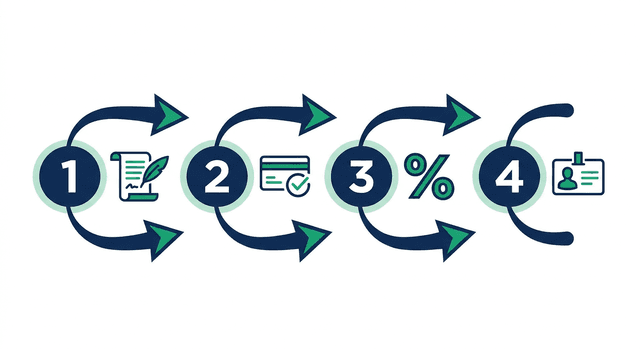
- IE: registered in one day at the House of Justice; no residence permit required for this step (full guide).
- Work permit: the entry ticket to the residency application (full breakdown including the April 16 amendment).
- Tax status: Small Business 1% for most; the IE's turnover becomes your income base for residency.
- Residence permit: once the income threshold is reached: online application, originals to the House of Justice, decision in 10-30 days.
Now step by step, with numbers and practice.
The work permit: entry ticket and the 10-day rule
An approved work permit is a required document for the work residence permit, and the amendment did not change that. The filing itself is mundane: the application asks for your work format (remote / on-site / hybrid), and the final step is a video call with the agency which, per a practicing lawyer in r/Sakartvelo, lasts about five minutes; in observed cases permits come back valid for a year (not the minimum six months), and three years for IT.
Then the subtlety almost nobody writes about: the 10-day rule. By regulation, once the permit is approved you must file a residency application within 10 days. But an exemption covers those who "work remotely and whose work does not require them to be in Georgia", and the agency, per the same lawyer, reads it in applicants' favor: it extends to people already living in Georgia, provided they are not here by virtue of the work itself (the classic case being an IE with exclusively foreign clients). The panic version, "permit approved, run for residency in 10 days or be fined", is not how it is applied to remote workers. They can file for residency when they reach the income threshold.
Residence permit requirements: thresholds and documents
The key threshold: income of 50,000 GEL over 12 consecutive months through the Georgian IE. You can file earlier than a calendar year if the threshold is already met. For fresh IEs without a 12-month history the threshold collision was resolved by separate clarifications; verify this point as of your filing date.
The document package (as assembled in service-provider practice; verify at filing):
- passport with a notarized translation no older than 60 days (~100 GEL);
- IE registration extract and status certificate;
- proof of 50,000+ GEL income over 12 months (declarations, statements);
- a bank statement; practitioners suggest keeping a cushion of around 18,000 GEL on the account;
- a tax clearance certificate;
- a photo (taken on site, 5 GEL).
Fees and timelines
| Review time | Fee |
|---|---|
| 30 days | 300 GEL |
| 20 days | 450 GEL |
| 10 days | 600 GEL |
Mechanics: an online application, then originals to the House of Justice within 10 days. The migration service interviews applicants rarely; most decisions are made on documents. The first permit is normally issued for one year.
The trap people discover last: the address
Residency requires address registration, and this is where the route stumbles most often. You will need either a notarized lease or the landlord's personal visit to the House of Justice. In the same thread a tenant describes exactly this trap: a non-notarized lease, a landlord abroad who wants no part of the procedure, and a person seriously considering moving apartments just for the permit. Check your landlord's position before filing; better, before signing the lease.
Renewal and the long game
The renewal application goes in at least 40 days before the current permit expires; the conditions (an active IE, turnover, tax cleanliness) must still hold. The long game: after 10 years of legal residence, permanent residency becomes available; and permanent residency, notably, is the one status that removes the work-permit question entirely.
Special cases
The IT residence permit does not replace the work permit. A live question from the thread: "does an IT residence permit holder need the work permit?" The lawyer's answer: yes; only permanent residency exempts you. The consolation: IT specialties get the permit for three years at once.
You are outside Georgia. For entering on work grounds there is the D1 immigration visa (per consultants' guidance, filed within 30 days of the permit approval), and a new C5 visa category for specific cases. Both are fresh and practice is thin; verify against your passport and scenario.
An IE with a single client. Residency cares about turnover, but if your only contract looks like employment (a fixed monthly amount, paid leave, a schedule, a title in the org chart), then the tax service can requalify the income, and the 1% status does not mix with salary. Lawyers in the thread mention 38 assessment criteria. Show the contract to a specialist before filing.
Three scenarios
A freelancer on the visa-free year, foreign clients. You can live and work without residency (no work permit needed after the amendment). Residency becomes worth it when you want stability: banking limits, leases, schools, no visa runs. Accumulate the 50,000 GEL turnover and file along the route above.
A family relocating for good. Count from the threshold: 50,000 GEL over 12 months averages ~4,200 GEL of turnover a month. With a stable flow, a realistic horizon from IE registration to the residency card is 13-15 months (a year of income history plus filing and review). Get the work permit early; it will be in the package anyway.
An IT specialist. The same route, but the permit comes for three years at once, meaning fewer bureaucratic cycles. The IT residence permit as a separate status does not remove the work-permit requirement.
How we handle it
GeoExperts has run this route end to end since 2017: IE registration in a day, the work permit (package, filing, video-call prep), the 1% status, and, once the threshold nears, the residency package including income certificates and the address question. 850+ clients; the first consultation is free: we will tell you straight away where your route will snag and what to prepare in advance.
Frequently asked
Do I need residency to open an IE? No. The IE registers on a passport; residency is a later step of the route, not a precondition.
Which comes first, the work permit or residency? The work permit: without it the work-based residency application is not accepted.
Is it true I must file for residency within 10 days of the permit? The rule exists, but remote workers with foreign clients fall under an exemption the agency reads in applicants' favor, including for people living in Georgia. Verify edge cases individually.
How much money do I need to show? 50,000+ GEL of IE income over the last 12 months; practitioners suggest a cushion of about 18,000 GEL on the account.
How much does it cost and how fast is it? 300/450/600 GEL for review in 30/20/10 days, plus the passport translation (~100 GEL) and a photo (5 GEL).
How long is the first permit and how do renewals work? Usually one year; renew at least 40 days before expiry with the conditions intact.
Can they refuse? Yes: an incomplete income history, tax debts, address problems, doubts about the reality of the activity. Most refusals are preventable at the package-assembly stage.
Message us on Telegram @GeoExpertsSaqartvelo or WhatsApp +995 551 278 585, and we will map your route to the card: what you have, what is missing, and when to file.
Ready to start?
Book a consultation or message us: we will tell you whether this service fits and how we would do it for your case.