
On 23 July 2026 Pavel Durov posted four sentences in his Telegram channel that made every business outlet in the region. The Telegram founder had spent a few days in Tbilisi in late June; a month later he called Georgia "a major business hub" and promised to be back soon.
If you are choosing a country for a solo business or an IT company, that reads like a signal. But Durov's post is four sentences, and a tax system is hundreds of pages. We traced each of his numbers to its source and put Georgia side by side with the two main alternatives on a relocant's shortlist: Armenia and Kazakhstan. Short version: Durov is right in spirit, imprecise in detail, and his post skips the one 2026 change every foreigner with a Georgian IE must know about.
Quick answer: where things stand in 2026
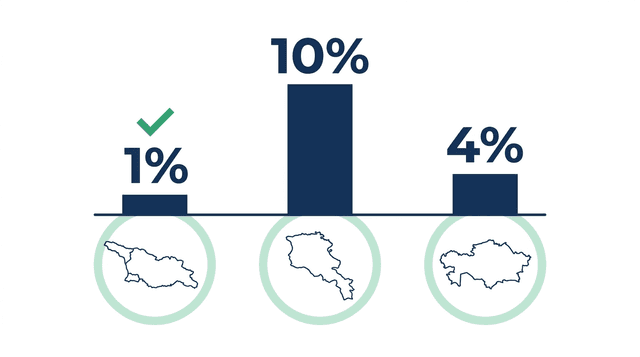
For a solo freelancer with foreign clients, Georgia remains the cheapest option in the Caucasus in 2026: an Individual Entrepreneur with Small Business Status pays 1% of turnover up to 500,000 GEL a year. Armenia charges 10% turnover tax on services (or 1% for certified high-tech companies), Kazakhstan moved to 4% on its simplified regime in 2026. Georgia's new entry condition: since 1 March 2026 some foreign IE owners need a work permit, though the April amendment exempted remote workers serving foreign clients. Details per country below.
What Durov actually wrote
Here is the post in full, no paraphrase (t.me/durov, 23 July 2026):
Very impressed with Georgia. The country is known for its warm people, ancient culture, local food and epic landscapes. But it doesn't stop there. Thanks to its government's business-friendly policies, Georgia is becoming a major business hub. The country's economy doubled in 5 years and is still growing by 8% a year. International tech companies pay 0% corporate tax and just 5% on dividends and salaries. Georgia is seriously underrated as a place to visit and do business. I'll be back very soon!
— Pavel Durov, Telegram channel, 23 July 2026
The post makes three checkable claims. Let's take them one by one.
"0% corporate tax and 5% on dividends and salaries": which regime is that?
Short answer: no single Georgian regime offers that combination. Durov merged two different preferential statuses into one sentence, and the difference matters a great deal to anyone actually registering a company.
| Virtual Zone (VZP) | International Company (ICS) | |
|---|---|---|
| Corporate income tax | 0% on profit from exported IT services | 5% (Estonian model, on distribution) |
| Dividends | 5% | 0% |
| Employee salaries | standard 20% income tax | 5% income tax |
| Property tax | standard | 0% (except land) |
| Who qualifies | LLCs doing IT work for non-resident clients | IT and maritime services, 2 years of track record |
| Constraints | services must be delivered from Georgia | non-core income capped at 2% of revenue |
The "0% corporate tax" is the Virtual Zone: zero profit tax on software and digital services sold to non-residents, plus 5% on dividends. But VZP salaries are taxed at the standard 20%; there is no "5% on salaries" there.
The "5% on salaries" belongs to International Company Status: 5% payroll income tax and 0% on dividends, but corporate tax is 5% on distribution, not zero. And ICS has a hard entry filter: the company (or its parent) needs at least two years of experience in a permitted activity, and income from non-permitted activities cannot exceed 2% of revenue. The conditions are laid out by Andersen Georgia.
Both regimes are real and both work. You just cannot assemble Durov's blended rate (0% profit plus 5% salaries) out of either one alone. A solo developer with an LLC is usually better off in the Virtual Zone; a company with a team on the ground in Georgia, in ICS. A freelancer without a legal entity needs neither: the 1% IE route solves it cheaper.
"The economy doubled in 5 years": depends how you count
In nominal dollars, true: Georgia's GDP grew from $16.0bn in 2020 to $38.1bn in 2025, more than double (World Bank, Civil.ge). But 2020 is the COVID trough, and the figure is a dollar nominal that bakes in lari appreciation and inflation.
Real growth is impressive too, just short of doubling: 10.6% in 2021, 11.0% in 2022, 7.8% in 2023, 9.4% in 2024, 7.5% in 2025, roughly +55–57% in real terms over five years. "Growing by 8% a year" is a fair read of the recent past: January–February 2026 came in at 8.4%, though the IMF projects a slowdown to 5.3% for 2026 (later revised up to 6.5%).
Same verdict as with the taxes: direction right, magnitude rounded up.
What the post leaves out: the work permit, since 1 March 2026
This is the thing anyone who googled "register IE in Georgia" after Durov's post needs to know. Since 1 March 2026, self-employed foreigners, IE owners included, must obtain a "right to work" permit. A veteran of r/Sakartvelo summed up how the community took it:
The new work permit system complicates things. You need to renew it every 6 months to 1 year. A giant pain in the ass. And yes, you need a work permit even if working here but 100% remote working for a foreign company if you are getting paid here.
But the story has a second act that most guides still miss: the amendments of 15–16 April 2026 exempted remote workers and freelancers serving foreign clients, as well as company founders and directors. The same thread caught it more precisely than many lawyers:
If you are an employee of a US company then you are probably not caught by the new regulations, because you are neither running a business not employed by a Georgian company.
A work-based residence permit still requires the permit as a mandatory document, foreigners already working have a transition period until 1 January 2027, and the criteria replacing the abolished 50,000 GEL threshold are still awaiting a Government Ordinance. The full mechanics are in our work permit guide; how it ties into residency is covered in residence permit via IE.
Georgia vs Armenia vs Kazakhstan: the 2026 table
Now the part Durov's post doesn't have: how Georgia's terms look next to its neighbours if you are a solo freelancer or a small IT business owner. Data as of July 2026.
| 🇬🇪 Georgia | 🇦🇲 Armenia | 🇰🇿 Kazakhstan | |
|---|---|---|---|
| Base solo regime | IE + Small Business Status: 1% of turnover | Turnover tax: 10% on services (min 4.5%) | Simplified regime: 4% since 01.01.2026 (was 3%; regions may cut to 2%) |
| Regime ceiling | 500,000 GEL/yr (~$180k); excess taxed 3%, two years over = status lost | 115M AMD/yr (~$300k); micro-business under 24M AMD = 0% | 600,000 MRP (~₸2.6bn); 185 activity types excluded |
| IT incentive | Virtual Zone 0%/5% or ICS 5%/0%/5% (see above) | High-tech 1% turnover tax through 31.12.2031 (≥90% income from approved activities, registry) | Astana Hub: CIT relief and 0% payroll tax for IT until 2029 (from 2026: ≥90% core income + exclusive software rights) |
| Work permit for IE | Yes, since 01.03.2026; remote workers with foreign clients exempted on 16.04 | No | No (for EAEU citizens) |
| VAT | registration from 100,000 GEL turnover | standard once out of the special regime | 16% since 2026 (was 12%), registration threshold halved |
| Banking for non-residents | accounts open, but with filters | PayPal cannot receive payments; Wise is a grey zone | tighter compliance, account requires an IIN |
Row sources: Armenia: easytaxes.am regime overview and the high-tech 1% conditions; Kazakhstan: the new Tax Code (Law No. 214-VIII of 18.07.2025, IE impact breakdown) and Astana Hub rules from 2026; Georgia: Andersen and our linked guides.
Three observations on top of the table.
Armenia's strengths don't show up in a rate table. Russian citizens enter on an internal passport, an IE registers without a residence permit, and there is no work permit at all. The 1% high-tech regime is fixed in law through 2031, a longer horizon than most Georgian promises. The flip side is payment infrastructure:
specifically receiving money on PayPal is not possible. You can otherwise have an account to use to pay for things.
If the client has Revolut they can transfer to Armenian banks very cheaply. Payoneer have terrible service, I'd avoid.
Kazakhstan got pricier and stricter in 2026. The new Tax Code raised the simplified rate from 3% to 4%, VAT from 12% to 16%, halved the VAT registration threshold and excluded 185 activity types from the simplified regime, legal and accounting services among them. Astana Hub remains generous, but from 2026 it demands ≥90% core income and exclusive rights to the software, a filter that screens out outsourcing setups.
Georgia still beats both on the rate, now with a status caveat. 1% against 10% and 4% is a gap nothing closes except Armenia's high-tech certificate. The 2026 condition is simple: figure out whether the work permit applies to you before registering the IE, not after. And remember that 1% is a status with terms attached: the 500,000 GEL ceiling, permitted activities, monthly declarations.
The honest part: what Georgia does not guarantee
We have handled Georgian registrations since 2017, so here is the inside view Durov's post can't give you. The rules move fast: the permit law passed in February and was rewritten in April, and the implementing ordinance still hadn't been published by July. Bank compliance keeps tightening: a non-resident account is harder to open today than two years ago. And the preferential regimes are statuses with conditions: they are granted, and they are revoked when conditions are breached. None of this cancels Georgia's rates, but all three points are worth knowing before the move, not after.
Frequently asked
What exactly did Durov say about Georgia? That the country is becoming a major business hub: the economy doubled in five years, grows 8% a year, and international tech companies pay 0% corporate tax and 5% on dividends and salaries. The post appeared in his Telegram channel on 23 July 2026, after a June visit to Tbilisi.
Is it true that IT companies pay 0% tax in Georgia? Partly. The 0% profit tax comes with Virtual Zone status: LLCs only, and only on IT services exported to non-residents; dividends are taxed at 5% and salaries at the standard 20%. The "5% on salaries" belongs to a different status, the International Company, where profit tax is 5%.
Do remote workers need a work permit in Georgia in 2026? If you work from Georgia for a foreign company or serve only foreign clients, the 16 April 2026 amendment exempted you. If your clients are in Georgia, or you are applying for a work-based residence permit, you need it.
Where are taxes lower for a freelancer, Georgia or Armenia? On the rate, Georgia: 1% of turnover versus 10% on services in Armenia. Armenia's high-tech 1% matches the rate but requires registry admission and ≥90% income from approved activities. In exchange, Armenia has no work permit and a higher turnover ceiling.
What changed for sole proprietors in Kazakhstan in 2026? A new Tax Code took effect: the simplified rate rose from 3% to 4%, VAT from 12% to 16%, the VAT registration threshold was halved, and 185 activity types were excluded from the simplified regime.
What is the limit of Georgia's Small Business Status? 500,000 GEL of turnover per year (roughly $180k). The excess is taxed at 3%, and two consecutive years over the cap cost you the status and move you to the standard 20%.
Can I register a Georgian IE remotely? Yes, via a notarized power of attorney with an apostille, with no personal visit required. Details in our step-by-step guide.
Should you move because of a Telegram post?
Georgia in 2026 is still the best bet in the Caucasus for a solo entrepreneur, and Durov got the big picture right. But between the post's "0% and 5%" and your actual tax bill sit the choice of regime, the status conditions and, for some foreigners, the work permit.
If you want your case run on real numbers, message us on Telegram or at info@geoexperts.ge: the first tax-planning consultation is free. We have supported IE and company registrations in Georgia since 2017: 850+ clients, average response within 5 hours.
Ready to start?
Book a consultation or message us: we will tell you whether this service fits and how we would do it for your case.