Georgia's work permit law for foreigners had a rare fate: it survived in its original form for six weeks. The requirement took effect on March 1, 2026 and caught everyone, including freelancers with a Georgian IE and foreign clients. Relocation chats panicked, media wrote explainers, and on April 16 parliament passed an amendment that carved remote workers and company owners back out. The problem: the internet still retells the March version; nearly every article in the search results was written in January or February and does not know about the amendment.
This is the full picture as of July 2026: who no longer needs the permit, who still does, why almost everyone applying for residency will need it anyway, and what the procedure looks like. A practical breakdown, not legal advice; check edge cases against your own setup, or ask us.
Quick answer
After the April 16, 2026 amendment, the work permit is NOT required for foreigners working remotely for foreign clients (including through a Georgian IE) or for company owners and managers. It remains mandatory for those employed by Georgian companies or earning income from Georgian sources. The catch: an approved permit is still a required document for the work-based residence permit, so most relocated IE holders will need it anyway, just for a different reason. Fees: 200 GEL (30 days) or 400 GEL (10 business days); the fine for working without a permit, for those in scope, is 2,000 GEL.
Timeline: how the law changed
| Date | What happened |
|---|---|
| 2024 | Labor migration amendments adopted with a delayed start |
| February 20, 2026 | Permit issuance rules approved |
| March 1, 2026 | Requirement in force, remote IE holders included |
| March-April 2026 | Panic wave: chats, Reddit threads, media explainers |
| April 16, 2026 | Amendment: remote workers, service providers to non-residents, short-term professional activity and company owners/managers carved out |
The speed of the reversal, six weeks, tells its own story: business pushback worked and the rules were corrected. International auditors documented both the original regime (KPMG Flash Alert 2026-117) and the carve-outs.
Who no longer needs the permit
Since April 16, 2026, four categories are out of scope:
- remote workers with no physical activity in Georgia;
- providers of services to non-residents: the classic freelancer with a Georgian IE and clients in the EU, US or anywhere outside Georgia;
- short-term professional activity, now formally recognized without a permit;
- company owners and managers: an LLC founder does not need a permit to own and run their own business.
The original March exemptions also stand: refugees and humanitarian-status holders, asylum seekers, diplomats, accredited journalists, investment residence permit holders, and persons under international agreements.
A useful live benchmark from the r/Sakartvelo thread where the amendment was discussed in real time: "You can operate without this permit now, as long as you don't derive income from local sources." Test yourself against the income source, not against where your laptop sits.
Who still needs it
- foreign employees of Georgian companies (the employer files the permit);
- work physically tied to Georgia and its local market: couriers, guides, tradespeople serving local clients;
- IE holders with Georgian-source income: if any of your clients are Georgian companies or individuals, you are in scope;
- the subtle case from the same thread: a freelancer contracted to the Georgian branch of a foreign company. The branch is a Georgian legal entity, so the income is most likely local. Check such setups before signing.
The fine for working without a permit, for those in scope, is unchanged: 2,000 GEL.
The catch: residency
Here is why it is too early to relax. The amendment removed the permit as a condition of work for remote workers, but did not touch its role in the migration chain: an approved work permit remains a required document for the work-based residence permit. Practitioners confirm it: in a Reddit discussion a member relays an immigration company's answer: the permit is needed for the residency application "even though you're a remote worker living in Georgia with IE and SBS".
Practical conclusion: if you plan to live in Georgia beyond a tourist year and apply for a work residence permit through your IE, you will need the permit either way: not to work, but as the entry ticket to the residency application. The from-scratch order: IE registration → work permit → tax status (usually Small Business 1%) → residence permit application. The full route with thresholds and fees is in the residence-permit guide.
The procedure, for those who file
The mechanics have not changed since March. Applications go through the labor migration portal; community reports call the process online and manageable.
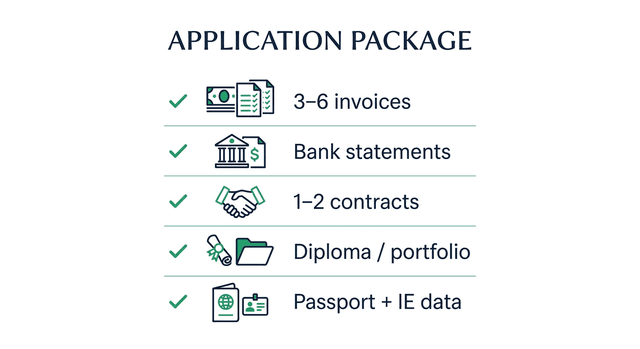
The self-employed package (per the applicant instructions):
- IE registration data: ID number, addresses, field of activity;
- qualifications: education, work history, portfolio, profiles like LinkedIn;
- a business plan with investment amounts and projected revenue;
- financial standing: recent invoices and acts (3 to 6 in practice), bank statements, 1 to 2 active contracts;
- a video interview with the Employment Agency.
Timelines, fees, renewals:
| Parameter | Value |
|---|---|
| Standard review | up to 30 calendar days, 200 GEL |
| Expedited review | 10 business days, 400 GEL |
| Validity | 6 months to 1 year; IT specialties up to 3 years |
| Renewal | file at least 30 calendar days before expiry |
| Working without a permit (in scope) | 2,000 GEL fine |
Our note from filings: collect six months of income documents into one folder before you start. Half of all delays are applicants sending statements one at a time.
Rejections happen
The permit is not a rubber stamp: r/Sakartvelo has a thread from an applicant who was rejected. From filing experience, the same things that raise approval odds also shorten the video interview: a specific business plan instead of a template, income documents without gaps, an activity description that matches the actual invoices. After a rejection, diagnose the cause before refiling; resubmitting the same package mostly reproduces the result.
One sour note from the amendment discussions: those who filed and paid before April 16 should not, by community accounts, expect the 200 GEL back.
Four typical scenarios
Living in Georgia, IE, foreign clients. No permit needed to work (services to non-residents). Needed for the work residence permit. Decide from your migration plans, not from chat panic.
Living outside Georgia with a Georgian IE and foreign clients. Not needed: you are both remote and serving non-residents. Just keep Georgian companies out of your client list.
Employed by a Georgian company, or serving Georgian clients. Needed. Employees are filed by the employer; IE holders with local income file themselves.
LLC founder running your own operations. After the amendment, owning and managing your company requires no permit. For hired foreign staff, your company files as the employer.
How we handle it
GeoExperts has been doing business registration and residence permit paperwork in Georgia since 2017, 850+ clients. We start with a diagnosis: whether your setup needs the permit at all; after the April amendment, "you don't" is a more common answer than people expect. When it is needed (most often for residency), we assemble the package including the business plan and income documents, file it, and walk it to the decision, video interview included. The first consultation is free.
Frequently asked
I freelance through a Georgian IE for foreign clients. Do I need the permit? Not to work: since April 16, 2026 you fall under "services to non-residents". For the work residence permit: yes, it remains a required document.
What if one client is a Georgian company? Georgian-source income puts you back in scope: file for the permit or keep local clients out.
Does an LLC founder need a permit to run their own company? No: the April 16 amendment carved out owners and managers.
How much and how long? 200 GEL for up to 30 calendar days, 400 GEL for 10 business days. Assembling the package usually takes longer than the review.
How long is it valid and how do renewals work? 6 months to 1 year, up to 3 years for IT; renewal applications go in at least 30 calendar days before expiry.
I was rejected. Now what? Diagnose the weak spot, usually the business plan or gaps in income documents, and refile stronger. The same package will mostly get the same answer.
Message us on Telegram @GeoExpertsSaqartvelo or WhatsApp +995 551 278 585, and one consultation tells you whether you need the permit at all, and maps the route to residency with documents and dates.
Ready to start?
Book a consultation or message us: we will tell you whether this service fits and how we would do it for your case.